Dear waste pickers and allies,
We are happy to share with you this special issue of “Struggles and Victories: Waste Pickers on the Frontline” that provide ideas for how waste pickers and other waste workers can protect themselves and advocate for safer working conditions in the face of COVID-19.
In solidarity,
Communications support team for GlobalRec.org
- 1. Recommendations
- 2. Shared Experiences from Waste Pieckers around the world
- 3. How is your organization dealing with Coronavirus?
# 1. Recommendations for Waste Pickers and their organizations against Coronavirus

Background
This document is meant to provide ideas for how waste pickers and other waste workers can protect themselves and advocate for safer working conditions in the face of COVID-19. The recommendations in this document are based on the feedback and advocacy content of dozens of waste picker organizations from around the world, reports on COVID-19 treatment and management, recommendations by the World Health Organization, as well as advice from epidemiologists[ref]WIEGO’s Cuidar project in Brazil, which has focused on the mapping of waste pickers’ health risks in the workplace, engaged with experts in epidemiology and labor medicine from the University of Brasília and the Health Foundation of Minas Gerais to elaborate recommendations for waste pickers.[/ref] on select issues for which there may be controversy (such as usage of face masks).
Representatives of the Global Alliance of Waste Pickers has attempted to validate and improve recommendations made by waste picker groups through a review of available literature on COVID-19, and has included in this document deeper discussions on issues such as mask use and the survival length of COVID-19 on surfaces so that waste picker organizations can make the most informed decisions possible for their workers and workplaces. This document is intended primarily as a resource for waste picker organizations, but is also useful more generally for other entities involved with waste collection of materials that are potentially contaminated by COVID-19.
Disclaimer
Research on the transmission of COVID-19 is still in its infancy and we will be updating these recommendations as we learn more. Where we have made recommendations based on incomplete data, we have tried to cite the different arguments and findings and have erred on the side of caution by deferring to the most conservative information available. In general, we advise that workers and organizations follow the advice of their national health authorities.
What is Coronavirus/COVID-19
How does COVID-19 spread?
Who is at risk?
What are the Symptoms of COVID-19?
What to do if you have symptoms
How waste pickers can protect themselves against Covid-19
General advice for all people
| Avoid places with many people, remain at least 1 meter (3 feet)[ref]WHO https://www.who.int/emergencies/diseases/novel-coronavirus-2019/advice-for-public[/ref] away from other people, and stay at home as much as possible. Some countries advice a distance of 2 meters (6 feet)[ref]CDC https://www.cdc.gov/coronavirus/2019-ncov/php/risk-assessment.html[/ref]. In closed spaces, new advice is to remain a minimum of 4.5 meters (15 feet) of distance from each other[ref]South China Morning Post https://www.scmp.com/news/china/science/article/3074351/coronavirus-can-travel-twice-far-official-safe-distance-and-stay[/ref]. | |
 |
Frequently wash your hands with soap and water for at least 20 seconds, and wash all parts of the hand. Wash your hands: upon returning home, before and after eating or smoking, after touching shared objects (including money), after sneezing or coughing, before and after touching your face. |
 |
Use sanitary gel with at least 70% alcohol[ref]CDC https://www.cdc.gov/coronavirus/2019-ncov/prepare/cleaning-disinfection.html[/ref], or straight 70%+ isopropyl alcohol, when hand washing is not possible. Sanitary gel only works if hands are not too dirty or greasy. |
| Regularly disinfect frequently used surfaces and objects like cell phones. | |
 |
Do not greet people with handshakes, kisses and hugs. |
 |
Avoid touching your face. Wash your hands before and after touching your face |
| Avoid sharing anything that touches the face including drinking glasses, straws, pillows, towels, smoking devices, etcetera. | |
 |
Cough or sneeze into the inside of your elbow, or into a tissue and immediately dispose of the tissue. Wash your hands immediately after sneezing or coughing. |
| Remove shoes and potentially contaminated clothing before entering your home. | |
| Avoid eating food that someone in your household has not prepared. | |
| Drink plenty of clean water, eat healthy foods, and get plenty of sleep to keep your immune system strong. | |
| If you have been exposed to anyone who was diagnosed with COVID-19, quarantine yourself for at least 15 days and inform others who may have also been exposed. | |
| Self-isolate by staying at your residence if you begin to feel unwell, even with mild symptoms such as headache, low grade fever (37.3 C / 99.1 F or above) and slight runny nose, until you recover. If it is essential for you to have someone bring you supplies or to go out (to buy food for example), then wear a mask to avoid infecting other people. | |
| Keep updated on the latest COVID-19 hotspots (cities or local areas where COVID-19 is spreading widely) and, if possible, avoid traveling to those places– especially if you are high risk. |
Additional advice for waste workers

| People in high risk groups should not go to work. All others should work alone or in small groups maintaining at least 1 meter (3 feet) of distance from each other. If workers are in groups, maintain the same groups day after day so that if someone falls ill with COVID-19 it will be easier to identify and quarantine others who were exposed. | |
 |
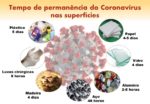
Assume that any recyclable or waste materials that you are handling may be contaminated by the virus. Coronaviruses are believed to live on surfaces for up to 9 days[ref]G.Kampfa, D. Todt, S.Pfaender, E.Steinmannb. Persistence of coronaviruses on inanimate surfaces and their inactivation with biocidal agents. Journal of Hospital Infection Volume 104, Issue 3, March 2020, Pages 246-251. https://doi.org/10.1016/j.jhin.2020.01.022[/ref]. |
| Avoid exposure to fumes or dust from waste materials, especially when waste is being dumped or compacted [ref]Doremalen N, Bushmaker T, Morris DH, Holbrook MG, Gamble A, Williamson BN, Tamin A, Harcourt JL, Thornburg NJ, Gerber SI, Lloyd-Smith JO, Wit E, Munster VJ (2020). Aerosol and surface stability of HCoV-19 (SARS-CoV-6 2) compared to SARS-CoV-1. medRxiv 2020.03.09.20033217. doi: https://doi.org/10.1101/2020.03.09.20033217[/ref]. | |
| Workers with long hair should tie their hair back to avoid contaminating their face. | |
| Wear gloves when working, but be aware that your gloves can easily contaminate surfaces and spread COVID-19 if not handled properly. Avoid putting your gloves in your pocket (better to store them in a designated plastic bag). Never touch your gloves to your face. | |
|
Wash hands with soap and water before and after collection routes and any time you remove your gloves. |
|
Have a minimum 70% alcohol solution with you to sanitize hands when water and soap are not available. |
 |
Try to work in well-ventilated places only. |
| Regularly clean commonly touched surfaces with at least 70% alcohol or soap and water [ref]National Geographic https://www.nationalgeographic.com/science/2020/03/why-soap-preferable-bleach-fight-against-coronavirus/[/ref]. | |
| Use work gear, including gloves, and cover your skin and hair as much as possible while working. Remove clothing (including shoes) and gear before entering your home. | |
| Shower after finishing your route and wash your collection clothes and gear daily. | |
| Do not sort materials meticulously and avoid touching and sorting materials that indicate illness, such as tissues, masks, containers for medications like cough syrup, etcetera, or that appear to be marked as hazardous. Avoid picking through materials you can’t properly see. | |
| Establish systems of communication with your colleagues so that people can be informed if someone falls ill or needs assistance. | |
| Establish protocols for if a worker is diagnosed with COVID-19. |
Face masks: to wear them or not to wear them?

There is a great deal of conflicting information about the effectiveness of wearing face masks to protect people from COVID-19, largely because masks can easily become contaminated and may actually increase one’s risk of exposure[ref]C Raina MacIntyre, Holly Seale, Tham Chi Dung, Nguyen Tran Hien, Phan Thi Nga, Abrar Ahmad Chughtai, Bayzidur Rahman, Dominic E Dwyer, Quanyi Wang. A cluster randomised trial of cloth masks compared with medical masks in healthcare workers. BMJ Open. 2015; 5(4): e006577. Published online 2015 Apr 22. doi: 10.1136/bmjopen-2014-006577. [/ref]. They may also give the wearer a false sense of security. At the present time these should only be used by healthcare workers. Most casual users have not been trained in the proper handling and fit of respirators, and most people who wear these cannot achieve a good facial seal at the mask edges. They also commonly contaminate the inside of the mask or their hands by touching the outside of the mask. Also, wearing a beard will prevent a person from getting an adequate facial seal.
Respirators like n95 or n99 face masks can protect people from contracting COVID-19 if they are exposed to an infected person as long as the mask is clean and fits snugly around the face. Respirator masks are in extremely short supply and should ideally be reserved for medical workers. Note that air purifying respirators with an exhalation valve might expel droplets from a cough or sneeze through the exhalation valve and so should not be worn by persons suspected of being infected.
Non-respirator face masks such as cloth masks and disposable medical masks are generally considered to be helpful when worn by a sick person to reduce the probability of them exposing others. They are not considered helpful in protecting the wearer from contracting COVID-19 from another person, since virus particles from a cough or a sneeze can float through the air and enter around the edge of the mask. They may reduce exposure but do not guarantee protection from all airborne material. It is unclear whether COVID-19 particles that have contaminated a surface can become airborne on a dust particle and inhaled, as might occur when contaminated waste produces dust when moved or compacted.
Consider wearing a mask while working if all of the following apply:
- You are exposed to dust or air from waste while on the job and/or you are in close contact with other people while on the job
- The mask creates a seal around your face
- You are careful to never touch the front of the mask
- You only place and remove the mask by touching the ear straps
- You wash your hands with soap or hand sanitizer before and after touching mask
- You are able to dispose of the mask after use
- You can replace the mask when it becomes wet
Don’t wear a mask:
- If you cannot dispose of the mask after use.
- If the mask may have become contaminated
Advocacy
Ask your cooperative, association or employer:
- To systematize COVID-19 infection prevention measures at the workplace, including systems of coordination so that workers can be informed if one of their workmates falls ill or needs assistance.
- To post updated information about COVID-19 and how your city is responding.
- To provide handwashing stations with clean water and liquid soap at the work site.
- To provide sanitary gel and protective gear for workers.
- To keep the work space well ventilated and to regularly sanitize commonly used surfaces.
- To guarantee compensation for workers who become sick from COVID-19; who are forced to remain at home to care for children out of school or infected people; or who must avoid work because they qualify as high-risk.
Ask residents:
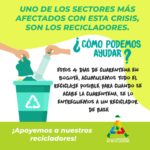
- To separate waste in the way that your organization deems safest for your workers. Many cooperatives are advising that households separate waste into three categories: organic waste, dry waste, and hazardous waste (which includes bathroom waste and anything that may be contaminated with COVID-19). Some cooperatives have launched campaigns asking residents to mark hazardous waste with a big red dot or some standard mark. Many places are asking that potentially hazardous waste be sealed in two plastic bags and set aside for at least 72 hours before placing it out for collection.
- To help workers with outdoor access to soap and water for handwashing, and share other resources that waste pickers may be lacking.
- To thank their local waste pickers for the services they are providing.
Ask leaders and government officials:
- To fund and provide access to protective gear (masks & gloves), supplies for hygiene (public hand washing stations with soap and water[ref]G.Kampfa, D. Todt, S.Pfaender, E.Steinmannb. Persistence of coronaviruses on inanimate surfaces and their inactivation with biocidal agents. Journal of Hospital Infection Volume 104, Issue 3, March 2020, Pages 246-251. https://doi.org/10.1016/j.jhin.2020.01.022 [/ref], hand sanitizers), and health guidelines for informal workers.
- To support waste pickers in their requests to households and businesses.
- To ensure that household waste collection continues throughout the crisis so that the community doesn’t suffer from additional infectious diseases.
- To ensure sufficient and rapid access to free COVID-19 testing and treatment.
- To fund educational outreach and distribution of supplies to communities without proper access to clean water and hygiene facilities.
- To make urgent arrangements to direct funds towards Living Cash Grant to all informal workers, regardless of nationality and tax filing status.
- To include the representation of organised workers in the informal economy in national and local discussions on economic and sanitary responses to COVID-19.
- To acknowledge waste pickers as front line workers deserving of special support and recognition.
Trends and final words
Things are changing very quickly as COVID-19 spreads around the world, including in the waste management sector. Many cities are suspending the collection of certain materials like bulky waste and recyclables[ref]https://www.wastedive.com/news/recycling-mrfs-prison-labor-suspensions-coronavirus-covid-19/574301/[/ref]. Many cities are asking residents to seal potentially contaminated waste in one or two plastic bags and dispose of it with regular residential waste. In England households where there may be a positive COVID-19 case are being asked to confirm a negative test result before disposing of possibly contaminated waste[ref]https://www.acrplus.org/en/municipal-waste-management-covid-19#great-britain[/ref]. If the test result is positive, some countries are asking residents to wait 72 hours before placing waste in communal waste collection bins. Waste drop-off sites are being shut down in many places, as are programs to collect recyclables. Where materials collection has been delayed or suspended, residents are being asked to seal and store it at home in a place away from people and animals.
Overall, the advice seems to be that essential mixed waste collection services must continue so as not to create an outbreak of additional infectious diseases on top of COVID-19, but that less critical services, such as the collection of recyclable materials (which are usually cleaner than other waste), may be suspended or delayed. Our advice is that if waste pickers who are not providing essential mixed waste collection services can afford to skip work and stay at home, then they should. Where waste collection must continue, all efforts must be made to restrict face to face contact between people, to securely wrap potentially contaminated waste, and for waste pickers to demand authorities to address worker safety and economic security.
This document will be updated periodically as the COVID-19 pandemic unfolds. If you have information to contribute to this work, please send it to: cuidar@wiego.org and to info@globalrc.org. More information about Cuidar project. Icons and images used are part of Cuidar project.
#2. Shared experiences from Waste Pickers Oganizations around the world against Coronavirus (COVID-19) ⬆️
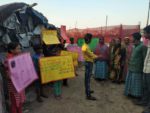
COVID-19 awareness driven by wastepickers’ children in India
As the world grapples to fight off the Novel Coronavirus, it has now become everyone’s responsibility to be mindful of the basic hygiene and adhere to them strictly. Chintan’s response towards the spread of COVID-19 has been developed to keep away from community transmission of this disease and save as many lives as possible. One » read the post
-
Waste pickers in Philippines face Coronavirus
We have received from Philippines a series of answers to our call for information of actions by waste picker organizations from 5 groups (4 from Metro Manila, and 1 from Cagayan de Oro City in southern Philippines) thanks to the EcoWaste Coalition. Organizations that participated in the survey: Samahan ng mga Mangangalakal ng Scrap » read the post
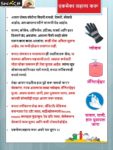
Fight the Battle against the Coronavirus COVID-19 (SWaCH, Pune, India)
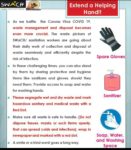
As we fight the battle against the Corona Virus COVID-19, it is important to remember that waste management and disposal is a crucial service. It is imperative that waste be collected and hygiene be maintained during such times as this helps contain the illness and also stems the spread of other infections that might be » read the post
Waste-picker & informal waste collectors of India seek safety measures from Indian government to safeguard against COVID-19
To Shri Narendra Modi Honourable Prime Minister of India New Delhi Subject: Safety of the waste-pickers and informal waste collectors during Covid 19 pandemic. Respected Sir We the members of the Alliance of Indian Wastepickers, welcome your address to the nation given on 19th March 2020, where you called sanitation workers defenders of the nation. » read the post
Call to national and local governments and citizens to assist and support Waste Pickers (SAWPA, South Africa)
The South African Waste Pickers Association is calling all men and women who are picking the recyclable materials within the waste stream, those on the landfills, streets, illegal dump-sites and in communities to take care of their health in this difficult time. We know that the recycling economy is still suffering the impacts of plastic » read the post
 Waste Pickers and Coronavirus (COVID-19) – Dear waste picker groups and allies around the world, In recognition of the urgent need to protect waste pickers against COVID-19 virus, we would like to collect and share recommendations for how waste pickers are protecting their health while maintaining their livelihoods. We are requesting information from you regarding the types of recommendations that waste » read the post
Recommendations to Prevent the spread of Coronavirus as Waste Pickers(ANR, Colombia)
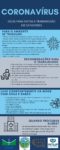
Fellow Waste Pickers: The following are some recommendations to prevent the spread of the Covid-19 virus (Coronavirus) in our work as public service providers of Recyclables management, within the framework of the Public Waste Management Service in Colombia. What is Covid – 19 or Coronavirus? It is a highly infectious disease caused by some viruses » read the post

Declaración de la Asociación Nacional de Recicladores de Chile Anarchi por el Coronavirus
Manifestamos nuestra preocupación por las consecuencias que está generando el Coronavirus en el pueblo de Chile. Al igual que todos los chilenos, estamos intranquilos y alarmados por el avance del virus y exigimos que se activen las todas las medidas necesarias para frenar su expansión ya que los trabajadores continuamos realizando las labores con mínimas » lee el artículo completo
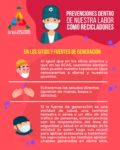
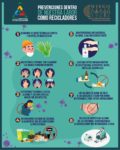
Prevenciones por el coronavirus dentro de nuestra labor como recicladores (ANR, Colombia)
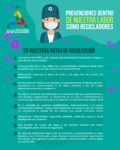
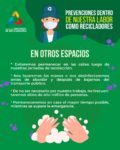
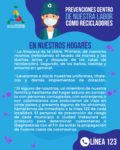
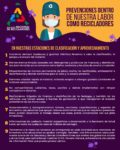
Compañeros recicladores y compañeras recicladoras de oficio: A continuación, algunas recomendaciones para prevenir el contagio del virus Covid – 19 (Coronavirus) en nuestra labor como prestadores del servicio público de aprovechamiento, en el marco del Servicio Público de Aseo en Colombia. ¿Qué es el Covid – 19 o Coronavirus? Es una enfermedad altamente infecciosa causada » lee el artículo completo
Recomendaciones de UTEP frente a la pandemia (Argentina)
Trabajadores y Trabajadoras de la Economía Popular al servicio del pueblo frente a la pandemia (hambre, dengue y coronavirus) Para cuidarnos entre todos y todas, aquellas personas que forman parte de los grupos de riesgo que NO vayan a sus espacios de trabajo: 1) Las personas con fiebre y algún síntoma respiratorio (tos, dolor de garganta, » lee el artículo completo
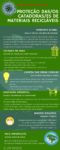
Proteção dos profissionais da catação de materiais recicláveis (MNCR, Brasil)
Devido a pandemia global do coronavírus Covid-19 reunimos aqui algumas orientações para ajudar na prevenção. É importante saber que as ações listadas são complementares as reivindicações por melhores condições de trabalho que devemos exigir dos poderes públicos para garantir segurança e qualidade de vida no trabalho, além de cuidado especial com a segurança alimentar em » read the post
Check in other languages (not yet translated) how other organizations are dealing with the COVID-19 crisis:
#3. Send your recommendation. How is your organization dealing with Coronavirus? ⬆️
Dear waste picker groups and allies around the world,
In recognition of the urgent need to protect waste pickers against COVID-19 virus, we would like to collect and share recommendations for how waste pickers are protecting their health while maintaining their livelihoods. We are requesting information from you regarding the types of recommendations that waste pickers and their organizations have for occupational protection in the time of COVID-19 virus.
We plan to compile this information from around the world, have it reviewed by doctors within our network to ensure that we are not spreading any risky advice, and then share strategies and recommendations with our network of waste picker organizations. If you have some recommendations or strategies to share with us, please do so as soon as you can.
It would be helpful to know the following information:
- Name of your organization and contact information.
- Location of your organization.
- Type of services provided (door to door collection, informal picking, dumpsite picking, etc).
- Strategies that waste picker have for protecting themselves.
- Recommendations and training/outreach strategies that your organization is providing to waste pickers.
- Are you making any requests to residents to dispose of their waste differently right now?
- Specific challenges you are facing in the face of covid19.
- Specific requests your organization is making to the government or others regarding the protection of waste pickers or informal workers more generally.
You can reply to this message with your response or leave a comment in the page dedicated to this globalrec.org/covid19 in our website.
Thank you and sending health and solidarity to you all.
The Global Alliance of Waste Pickers
Materials received