Alex Cardoso has become the first waste picker known to have earned a doctorate. He defended his thesis not in a lecture hall, but in the territory, surrounded by the workers whose knowledge he brought into the academy.
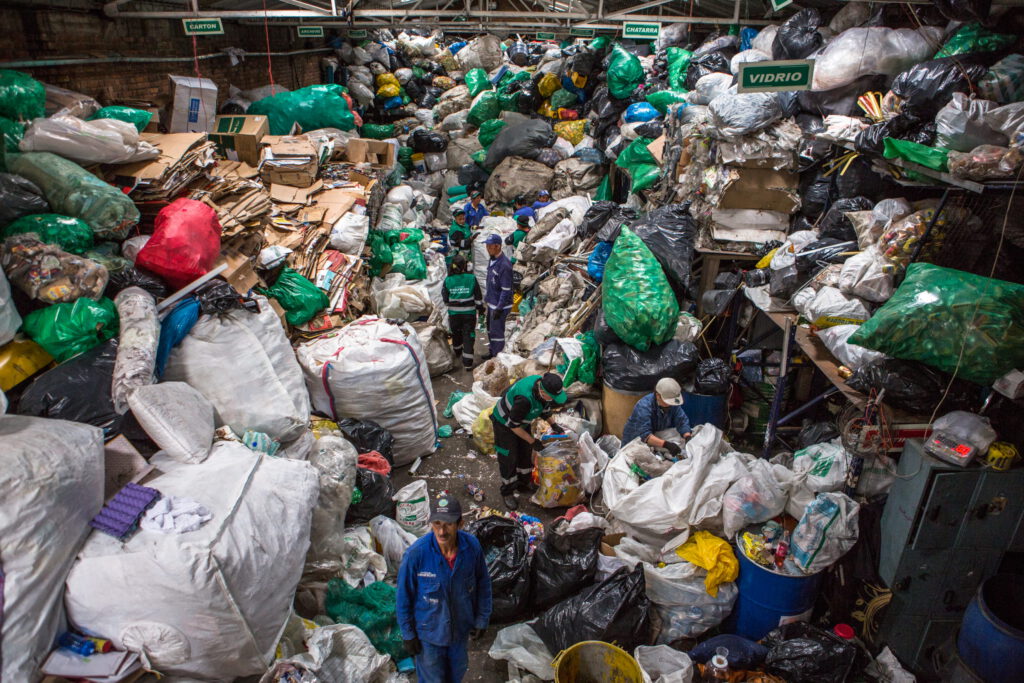
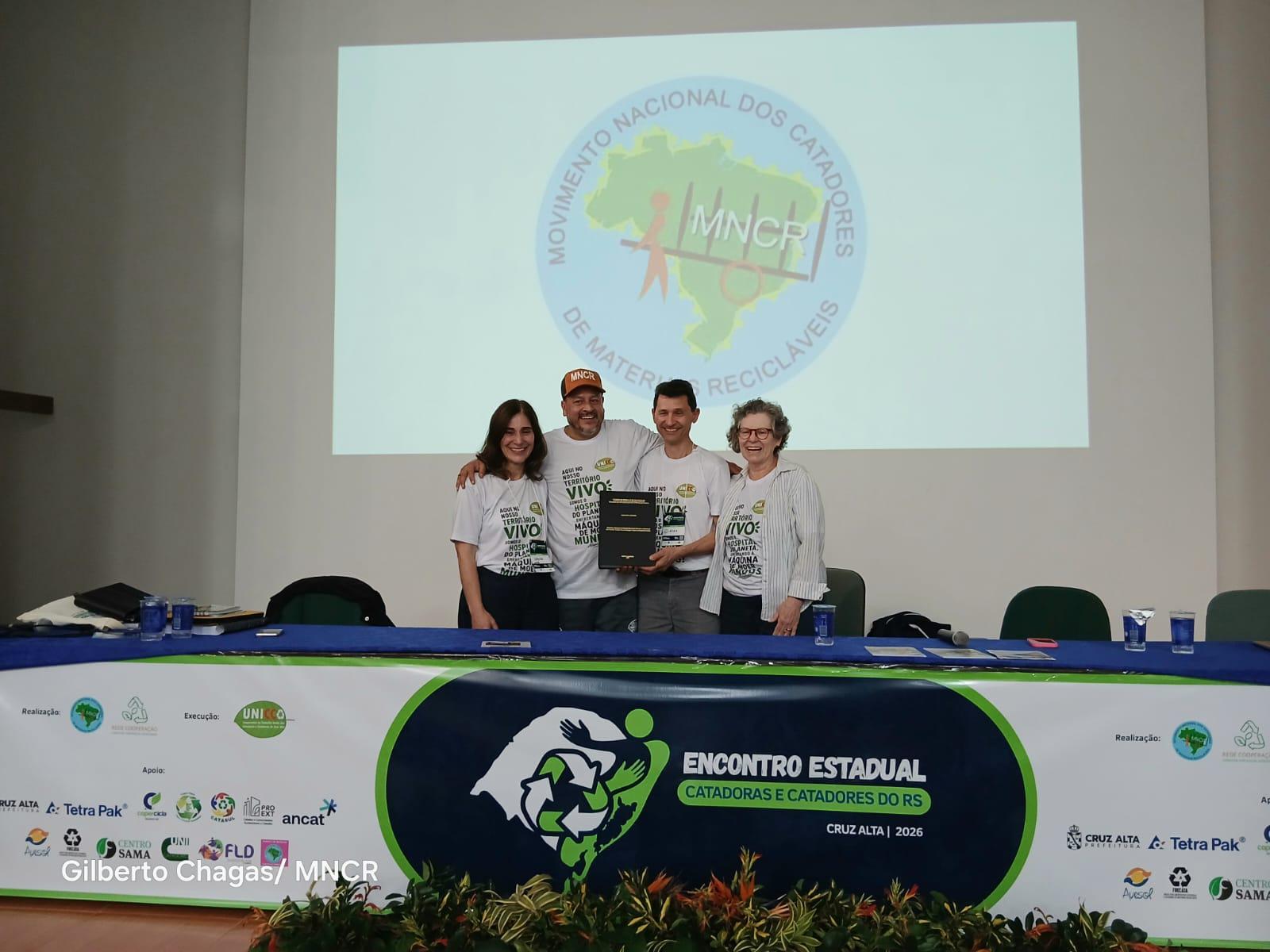
On 2 September, in the city of Cruz Alta, in the Brazilian state of Rio Grande do Sul, a doctoral defence took place that broke almost every convention of the ritual. The examining committee was there. The university was there. But so were the sorting shed, the cooperative, the cart, the bales of recyclable material, and the waste pickers themselves, gathered for the state assembly of the National Movement of Waste Pickers (Movimento Nacional dos Catadores de Materiais Recicláveis, MNCR).
The candidate was Alexandro Cardoso, known throughout the movement simply as Alex. Third-generation waste picker. Member of the Unicca cooperative. Longtime organiser with the MNCR. And, as of that afternoon, Doctor.
For the International Alliance of Waste Pickers, this is not a human interest story. It is a structural argument, made in public, about who is entitled to produce knowledge about our work.
Twenty years outside the classroom
Alex began working before he understood what work was. He is the son and grandson of waste pickers in Porto Alegre. He left school in the sixth grade, had his first child at sixteen, and spent the following two decades doing what millions of informal workers do: surviving, and supporting a family with the income that survival produced.
Two decades later, in 2014, he walked through the open door of a school and went back. He returned through Brazil’s adult education system, Educação de Jovens e Adultos (EJA), the public pathway designed for people whose schooling was interrupted by work. He completed basic education, entered an undergraduate degree in Social Sciences at the Federal University of Rio Grande do Sul (UFRGS), continued into a master’s in Social Anthropology, and then into the doctorate.
This trajectory is worth stating in technical terms, because it is a policy result and not a personal miracle. It rests on free public universities, on adult education provision, and on affirmative action policies that opened Brazilian public higher education to working-class, Black and peripheral students. Remove any one of those three and Alex’s degree does not exist. That is precisely why they are worth defending.
Throughout it all, he never stopped collecting. As he puts it, researchers usually learn the theory and then go to the field. He was in the field long before he imagined the academy would ever be an option.
The thesis: three concepts built between the sorting shed and the library
Alex’s thesis is titled Waste Pickers Confront the World-Grinding Machine: Living Territory and Popular Recycling in the Unicca Cooperative. It asks a deceptively simple anthropological question: how do waste pickers survive, sustain themselves and build a life in the face of everything arranged against them, materially and symbolically?
Three concepts organise the answer, and each one deserves attention from anyone working on waste, labour or climate policy.
The World-Grinding Machine. This is Alex’s name for the economic model that concentrates wealth and power, extracts labour, destroys ecosystems, and then distributes the consequences of that destruction with brutal inequality. The people who contribute least to the ecological crisis are consistently the first to lose their homes, their territories, their livelihoods and sometimes their lives. Waste is where this asymmetry becomes visible: what one part of society discards, another part is expected to absorb.
Living Territory. Against the machine, Alex describes territories that resist by reorganising economic relations around solidarity, collective work, sharing and care. A waste picker cooperative that organises popular recycling is not only running a collection service. It generates income, incorporates people who have been systematically excluded from formal labour markets, and keeps tonnes of material out of landfill. It is a functioning demonstration that the economy and the relationship with nature can be organised differently.
Hospital of the Planet. While the machine destroys, thousands of hands repair. Many of those hands are Black, poor, peripheral and female. They perform a substantial share of the recycling that actually happens, in Brazil and across the global South, and they do it largely without recognition, adequate remuneration or social protection.
These are not metaphors dressed up as theory. They are analytical categories produced from inside the labour process, and they carry direct policy consequences: for the recognition of waste pickers as environmental service providers, for the design of extended producer responsibility schemes, for procurement rules that contract cooperatives, and for any credible just transition framework.
A collective defence
Alexandro Cardoso broke with the usual conventions of a doctoral defence. In addition to bringing the university into the living territory, he designed the event for around 150 leaders of the MNCR, with an online broadcast and interpretation into English and Spanish, so that leaders from other countries could participate. More than a defence held in the territory, Cardoso carried out a truly collective defence.
When invited to present his work, he stood alone before the audience. He introduced the title of the thesis, the research question, its context, and the methodology he calls the “researcher who comes from within”. This approach brings together documentary research, participant observation, dialogue with authors and, above all, the experience of a researcher investigating his own trajectory: in this case, a waste picker researching the cooperative of which he is a member.
In the second part, the defence took a different form. Alex began asking questions to the waste pickers. Showing an image of a recycling shed, he asked: “What is this?” The audience began to answer, in dialogue: “It is where we have work. It is where we welcome people. It is where we distribute income. It is where we carry out training and planning.” From this collective response emerged the concept of the Living Territory.
From there, further questions and the participation of the audience gave shape to the other concepts developed in the thesis: the Hospital of the Planet, Popular Recycling, and the World-Grinding Machine. The research did not portray waste pickers as objects to be explained; it recognised them as subjects who produce knowledge, theory and ways of understanding and transforming reality.
After this collective construction of the concepts, Cardoso presented a slide announcing that, from that moment on, the defence would truly begin. He then invited all the women and men waste pickers to take the space where he had been standing. With flags, songs and a large banner reading “Here we are the Living Territory and the Hospital of the Planet confronting the World-Grinding Machine”, the audience took the centre of the defence.
Enedina Teixeira, manager of the Unicca Cooperative, presented the cooperative’s history and organisation. Stefanni Guedes and Paula Aiedo, MNCR leaders, together with Lidiane Jaques, president of Unicca, and Tânia Cardoso, a historic waste picker and Alexandro’s mother, took on the presentation of the defence, reading excerpts from the thesis conclusions.
At the end, Professors Simone Bochi Dorneles and Márcia Borges Umpierre captured one of the deepest meanings of that moment: the greatest finding is not simply Alexandro Cardoso’s achievement, but the capacity for knowledge production developed and articulated by waste pickers themselves.
Since returning to education, Cardoso has contributed through numerous articles, books and other academic works that strengthen the collective voice of waste pickers. His books include Do Lixo a Bixo (2021), O Eu Catador (2022), Catando e Organizando (2024) and Ser ou Não Ser, Eis a Educação (2026). His work seeks not individual recognition, but collective empowerment and strengthening. That is what gives this doctorate a different kind of force: the research was collective, the defence was collective, and the construction of knowledge was collective. The title may bear Cardoso’s name, but it belongs to the whole waste picker community.
From research object to research subject
Brazil recognised the occupation of catador de material reciclável in the national occupational classification in 2002. In 2010, the National Solid Waste Policy (Law 12.305/2010) formally incorporated waste picker cooperatives into the country’s waste management architecture. These were victories won by organised workers, not gifts from the state.
What happened in Cruz Alta belongs to the same sequence, on different terrain. For decades, waste pickers have been among the most studied populations in the environmental and social sciences: measured, photographed, quantified, interpreted. Studied from the outside. Alex’s defence inverted that relationship. The waste picker was not sitting there to be explained. The waste picker was producing theory.
This is what makes the event technically significant rather than merely moving. Knowledge produced from within the labour process reaches things that external observation does not: the internal economics of a cooperative, the logic of price formation for scrap, the informal arrangements that make collection routes viable, the gendered division of labour in the sorting shed, the meaning workers attach to what they do. Research designed with waste pickers rather than about them produces better data, better analysis and better policy.
No one should walk through the door alone
Alex is explicit that the title changes nothing about who he is or where he stands. He remains a waste picker. He intends to keep working in the cooperative and in the movement, and to use what he has learned to strengthen public policy for popular recycling.
He is equally explicit about what he does not want: to be an exception. He does not want this to be remembered as the extraordinary story of one waste picker who made it. He wants waste pickers with master’s degrees and doctorates. He wants the sons and daughters of waste pickers inside universities. He wants Indigenous people, quilombola communities, workers and young people from the peripheries producing science, running institutions and sitting in the rooms where decisions about their territories are made.
When someone who came from below occupies a space historically closed to the poor, they should not shut the door behind them. They should hold it open.
For IAWP and its affiliates, that is the practical agenda this achievement hands us. It means demanding access to education as a labour right, not a private aspiration. It means insisting that research on waste picking be co-designed and co-authored with waste picker organisations. It means bringing waste pickers into policy negotiations as experts, not as testimony. And it means remembering that recognition of our knowledge is inseparable from recognition of our work, our income and our rights.
The doctorate ends. The struggle does not.
When one waste picker moves forward, the whole category has to move with them.
Alex Cardoso is a waste picker, a member of the Unicca cooperative in Cruz Alta, Rio Grande do Sul, and an organiser with the National Movement of Waste Pickers of Brazil (MNCR). He is the author of Do Lixo a Bixo (2021), O Eu Catador (2022), Catando e Organizando (2024) and Ser ou Não Ser, Eis a Educação (2026).
Article by Nicolas Martinez
Communication Manager
IAWP.