By Clarissa Maçaneiro Viana, research coordinator of the IAWP
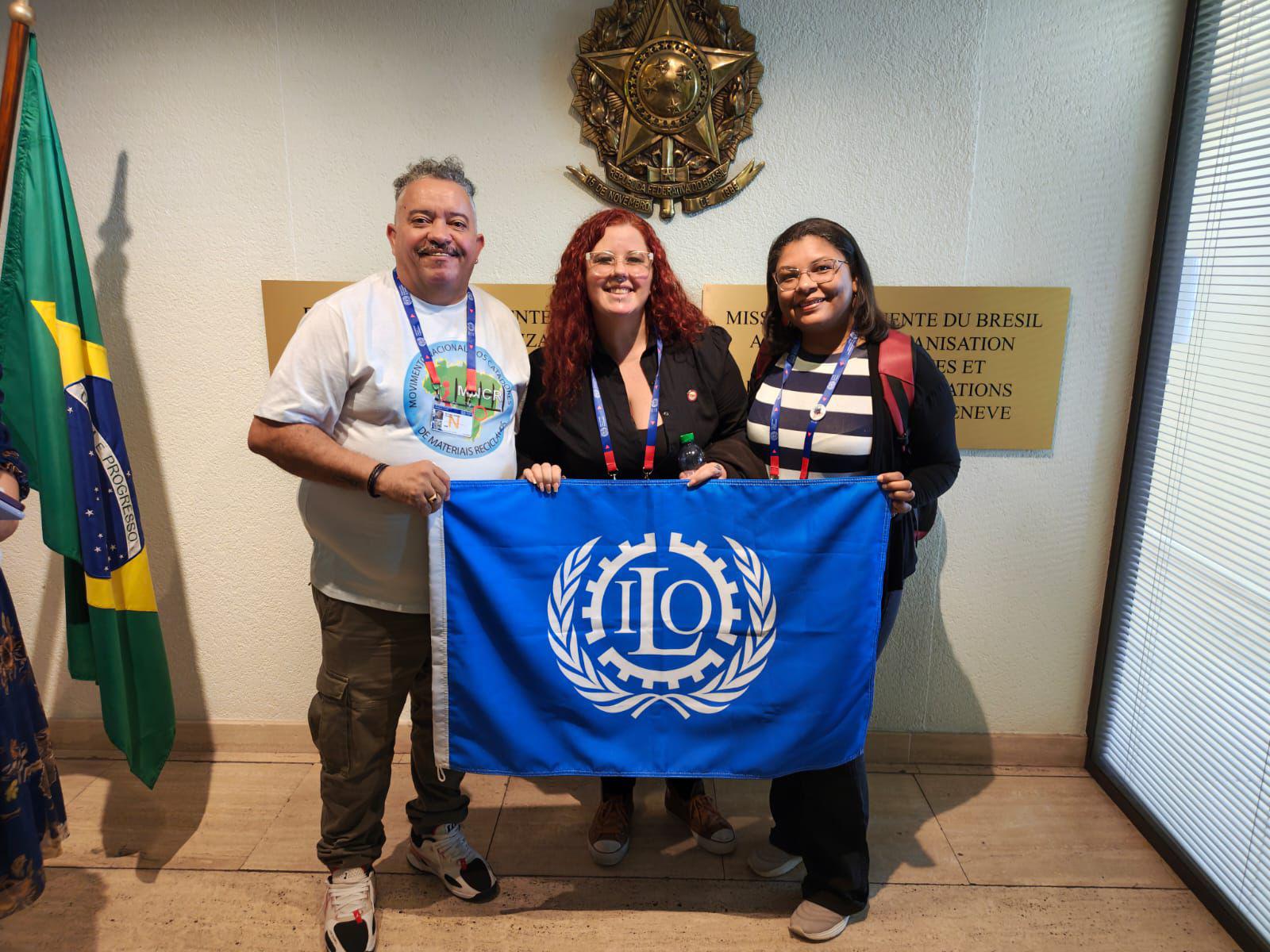
“After four years here, this is the first time we have taken part with the IAWP’s own badge. It is a very strong victory for our category of waste pickers, who stand alongside others [categories] such as street vendors, domestic workers and home workers.(…) It was very good to be here once more, and we hope to be back next year – now with our own badge, and bringing more delegates from other continents,” said Severino Lima Jr.
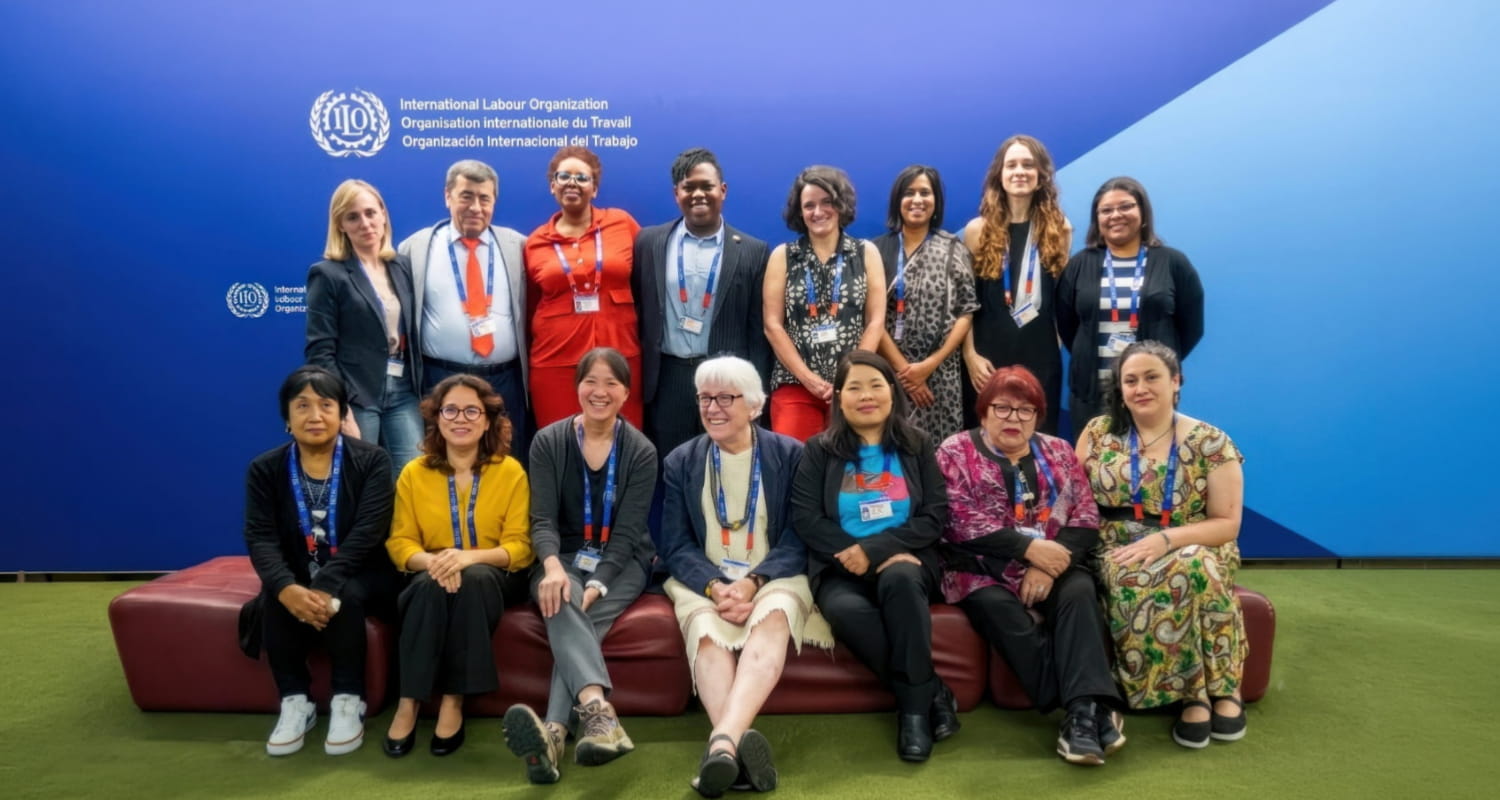
This past June, I had the privilege of representing the International Alliance of Waste Pickers (IAWP) at the 114th session of the International Labour Conference (2026), the annual Conference of the International Labour Organization (ILO), in Geneva. For the first time, we took part with our own badge as a formally invited observer – an important milestone for the IAWP and recognition that waste pickers should have a stake in the global conversation about decent work.
Alongside me was our President, Severino Lima Jr. We followed the discussions in the thematic committees, took part in meetings with diplomatic representatives and ILO staff, and engaged in side events and consultations on the solidarity economy, tripartite social dialogue and the transition to formality.
This year’s Conference discussed several topics, including resolutions on gender equality, tripartite consultation and social dialogue, and the standard-setting discussion on decent work in the platform economy.
The resolution on gender equality
The Conference adopted the Resolution concerning the ILO transformative agenda for gender equality in the world of work, which noted that women are disproportionately represented in the most insecure forms of work, including informal work. Amongst other important points, the Resolution calls on governments,employers’ and workers’ organisations, with ILO support, to develop, implement and monitor strategies that address informality through gender-responsive and intersectional measures. This includes promoting the transition to formality, informalisation and to strengthen the organisation as well as the representation of women workers, including those in the informal economy.
For women waste pickers, this is far from abstract. Across the world, they often carry the heaviest burdens and the least recognition: lower and more precarious incomes, exposure to harassment and violence, and the double shift of paid work and unpaid care. The discussions reaffirmed that gender equality must be built into how decent work is defined and delivered, an outcome that is fundamental for the Alliance.
The resolution on tripartite consultation and social dialogue
The Recurrent Discussion Committee on Social Dialogue and Tripartism reached several conclusions that were of direct relevance to the sector. It noted that workers and employers in the informal economy face persistent challenges and structural barriers, both in their transition to the formal economy and in exercising their right to organise and bargain collectively. Decent work and sustainable enterprises, it found, require active labour market policies and effective measures to support that transition.
The conclusions also urged Member States to strengthen the representation and participation of women, youth, and groups disproportionately affected by or at risk of informality, through the role of representative employers’ and workers’ organisations. It also called on Member States to support representative employers’ and workers’ organisations in their efforts to expand their role in representing workers and economic units in the informal economy in social dialogue processes and institutions.
For organised waste pickers, social dialogue is the very mechanism through which cooperatives and associations win contracts, recognition and protection from municipalities, governments and companies. Strengthening social dialogue at the international level firms up the ground beneath their negotiations at home.
A new Convention on platform economy
After a two-year negotiating process, the Conference adopted the first-ever international labour standard for platform work: the Decent Work in the Platform Economy Convention, 2026 (No. 193).
The Convention has a fundamental role in guaranteeing minimum standards applicable to them. Among its key provisions, it:
- Affirms that fundamental rights at work apply to the platform economy;
- Requires measures to prevent occupational accidents and diseases, including the right of workers to remove themselves from a dangerous work situation without undue consequences;
- Requires measures to protect workers against violence and harassment, including violence and harassment perpetrated online or involving third parties (such as clients and customers);
- Requires the correct classification of digital platform workers as to the existence or non-existence of an employment relationship, guided mainly by the facts relating to the performance of work and to the worker’s remuneration or payment, among other elements;
- Guarantees that workers are paid in full and on time, with employees assured at least the applicable minimum wage and compensation for work-related costs, and asks States to consider extending the same wage protection to platform workers who are not in an employment relationship;
- Ensures that digital platform workers have no less favourable protection, including access to social security protection, than those applicable to other workers with the same classification of status in employment;
- Requires platforms to disclose when automated systems are monitoring workers, and how those systems shape the work and access to it;
- Strengthens protection against the unfair suspension or deactivation of a worker’s account, requiring human involvement in any decision that withholds Pay or suspends or deactivates an account;
- Entitles workers to a documented explanation whenever an automated system makes a decision affecting them;
- Protects digital platform workers’ personal data and ensures that it is processed only for the legitimate purpose for which it was collected;
- Prohibits the suspension or deactivation of a worker’s account, or the termination of their employment or engagement, when based on discriminatory or unlawful grounds;
- Prevents abuses of, and provides adequate protection to, migrants and refugees in the course of their recruitment, engagement and work as digital platform workers.
These protections are not a ceiling: they are the base which ratifying countries should build upon, giving them concrete effect through national law and practice while going further wherever possible and needed.
This Convention, I believe, is a fundamental instrument for guaranteeing that all workers who provide services for platform companies, whether employees or not, are assured decent work. Although the discussions were tense at times, and concessions were made in order to secure the Convention’s adoption, it is an instrument with great potential to bring about change, particularly given that many countries still have no legislation regulating this kind of work.
It is worth noting that the Convention has a broad scope of coverage, applying to digital platform workers regardless of the sector of the economy in which they work. When people think of digital platform work, they tend to picture couriers and drivers, but the standard can reach far wider.
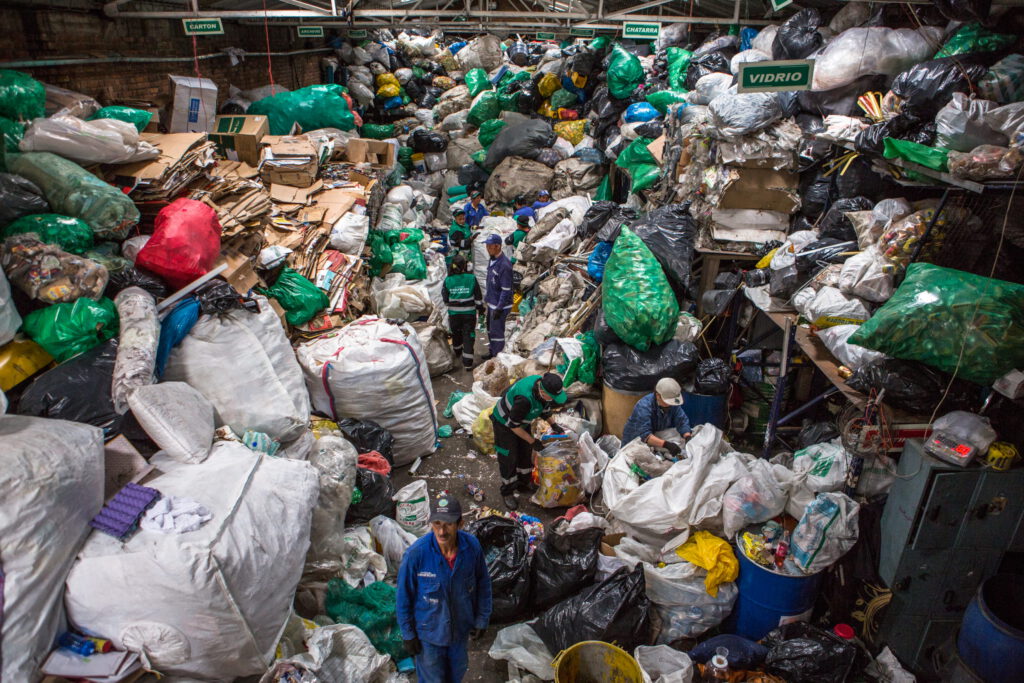
This discussion is relevant to the IAWP precisely because digital labour platforms are already a part of waste pickers’ reality. Across the world, waste management is increasingly subject to a process of “uberisation”. A growing number of companies launched app-based platforms to offer waste and recyclables collection to anyone willing to pay. Some present themselves as partners to waste pickers, promising better prices for collected materials. Yet it is frequently unclear whether joining such an app genuinely benefits waste pickers or simply absorbs them into a model they do not control; one that draws them away from the cooperatives and systems that could otherwise secure them autonomy and independent access to waste.
Digital labour platforms tend to individualise labour relations, which can be a concern for waste pickers’ organisations. When a waste picker can connect directly to an app, the incentive to join a cooperative weakens, and decades of collective organising can be quietly undone. Platforms decide routes, prices, ratings and access to work through algorithms that are rarely transparent, so waste pickers lose autonomy over what to collect, where, and at what price. Dynamic pricing set by a platform can create severe income instability, and the data generated by waste pickers (routes, volumes, materials, customer relationships) holds real commercial value, yet it accrues to the companies rather than to those who produce it.
Many companies profit twice over: they charge consumers a fee to have their recyclables collected and then sell on the high-value materials they receive. Those materials are precisely the income base of waste pickers. By capturing both the collection fee and the resale value, these companies overlook waste pickers, devalue their work and push them further to the margins.
None of this falls evenly. Platforms tend to reproduce the inequalities that already exist: women waste pickers, racialised workers, and migrants face specific barriers of digital access, language and safety, and “uberisation” affects each of these groups differently. Waste pickers who lack access to or familiarity with app technology are excluded altogether, which makes such platforms a potential source of direct competition for the most vulnerable in our sector.
Moreover, these companies are often well-financed and technologically sophisticated, yet a great number of them have short lifespans, especially those with little real engagement with waste pickers. They run for a few years, disrupt existing supply chains and then collapse, leaving waste pickers without the income sources and market arrangements they had come to depend on.
It is against all of these risks that the new Convention matters most: a binding international standard that insists fundamental rights apply regardless of employment status, demands correct classification based on the facts of the work, and subjects algorithmic management to transparency and accountability. This gives waste pickers a powerful reference point as “uberisation” reaches waste management.
A landmark and the work ahead
The adoption of Convention No. 193 sets an important landmark in the global conversation about decent work in the platform economy. It represents a major step in ensuring that technological innovation and new business models go hand in hand with workers’ rights. Its ratification by Member States is fundamental to ensure its effectiveness and application in national contexts.
For the IAWP, the Convention is a tool to carry home: into negotiations with municipalities and companies, advocacy against extractive digital platform models, and into the long work of ensuring that, as waste management changes, waste pickers are not left behind.