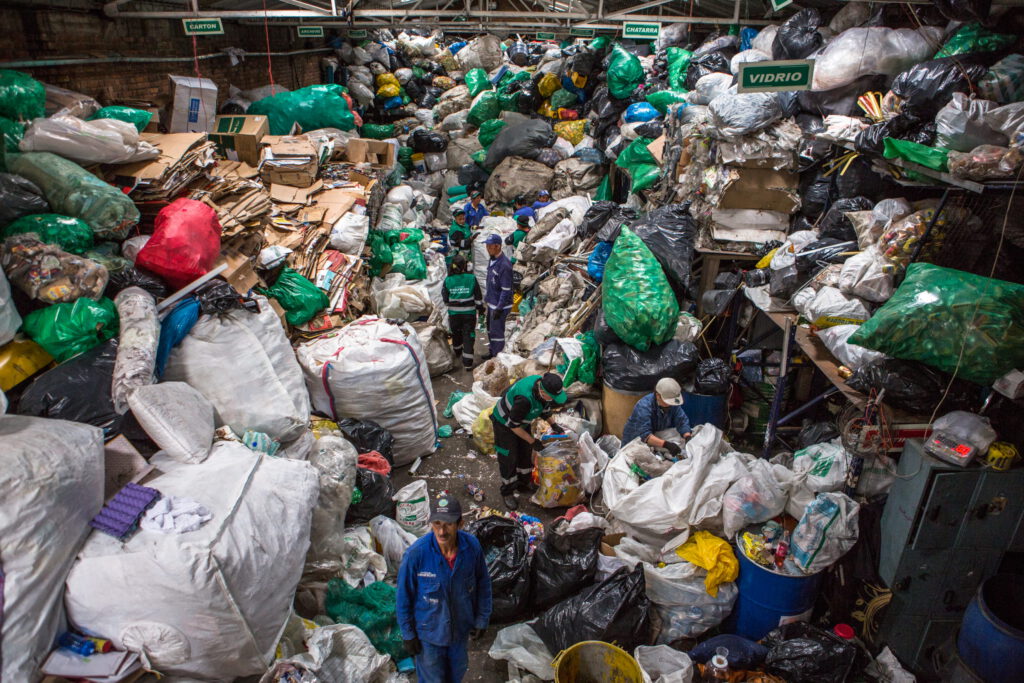

Article by: Nicolas Martinez and Clarissa Maçaneiro Viana
After more than three decades of struggle led by the National Association of Waste Pickers of Colombia (ANR), the government has taken a significant step towards justice and recognition. With the adoption of Decree 0271 of 2026, “System of Protection for the Lives of Waste Pickers”, the Ministry of Labour establishes a social protection framework that recognises waste pickers as workers entitled to special protection, advancing long-standing demands of the movement. This achievement reflects years of organisation, legal advocacy and collective resistance by waste picker organisations, which have sustained a constant struggle for the recognition of their rights, their dignity and their essential role in society. In addition, this approach aligns with the Transition from the Informal to the Formal Economy Recommendation, 2015 (No. 204) of the International Labour Organization (ILO), which recommends that the transition process progressively extend social security coverage to all workers in the informal economy, establish social protection floors and include occupational safety and health measures.
The decree aims to guarantee social security rights for waste pickers who are independent workers affiliated with waste picker organisations (non-profit organisations constituted entirely by associated waste pickers) and earn less than one minimum monthly wage.
The protection network rests on four main pillars. First, for health, waste pickers not yet enrolled in the General System of Social Security in Health (SGSSS) under the subsidised regime are prioritised, ensuring access to medical care, hospital services, and preventive programmes. Second, for pensions, waste pickers can access the Pension Contribution Subsidy Programme (PSAP) to benefit from solidarity subsidies, provided they meet the income and permanence requirements, ensuring they receive financial support to save for retirement. Third, for elderly protection, those who cannot access the PSAP may join the Complementary Social Service of the Periodic Economic Benefits (BEPS) scheme1, with contributions paid by waste picker organisations equal to 5% of the worker’s monthly income, or receive benefits through the Colombia Mayor programme2, providing older adults with regular cash support. Fourth, concerning occupational risks, waste pickers organisations are responsible for affiliating waste pickers to the General Labour Risks Scheme (SGRL), ensuring protection, medical care and compensation in case of work-related accidents or illnesses.
Crucially, this framework recognises that recycling is an essential work for the country and that social protection must not entail a reduction in the incomes of those who carry it out. This represents a shift towards a more inclusive model of labour protection, one that responds to the realities of workers engaged in the informal economy.
Beyond its technical provisions, this decree represents a broader political recognition: that waste pickers are fundamental to environmental sustainability and circular economy systems. By affirming that no one who works should be excluded from social protection, Colombia is advancing in closing historical gaps and in building a more just and inclusive society. It also sets an important precedent for other countries facing the challenge of integrating waste pickers into social protection systems.
“This decree is the result of decades of struggle by waste pickers in Colombia, who have demanded to be recognised not as beneficiaries, but as workers with rights,” said Nohra Padilla Herrera, leader and spokesperson of waste picker associations in Colombia and member of the International Alliance of Waste Pickers (IAWP). “It demonstrates that it is possible to build policies that protect our livelihoods while recognising our contribution to the country and to the environment. The challenge now is to ensure its effective implementation.”

The IAWP celebrates this progress as part of a broader global movement towards a just transition that includes waste pickers. Around the world, these workers continue to face exclusion from social protection systems, despite their fundamental role in sustaining recycling and preventing environmental harm. Colombia’s experience demonstrates that inclusive policies are possible when waste pickers are organised and actively participate in decision-making processes.
At the same time, the path forward requires sustained commitment. Effective implementation, adequate resource allocation and the meaningful participation of waste picker organisations will be key to ensuring that the provisions of the decree translate into real improvements in people’s lives. In a context where countries are advancing circular economy and climate action agendas, the inclusion of waste pickers in social protection systems must be understood as an essential component of a just transition.
For waste pickers in Colombia, Decree 0271 of 2026 goes beyond a regulatory advance: it is a recognition of their work, their rights and their dignity. It is a step towards a future where no one who works is left outside social protection.
1 The Periodic Economic Benefits (BEPS) individual account programme allows low-income individuals without mandatory coverage to contribute voluntarily to an individual savings account, providing them with a pathway to accumulate retirement benefits and access a complementary social protection mechanism in old age.
2 The Colombia Mayor programme is a national social assistance programme providing a non-contributory old-age pension in the form of cash transfers to elderly people who are vulnerable, lack a pension or live in extreme poverty.