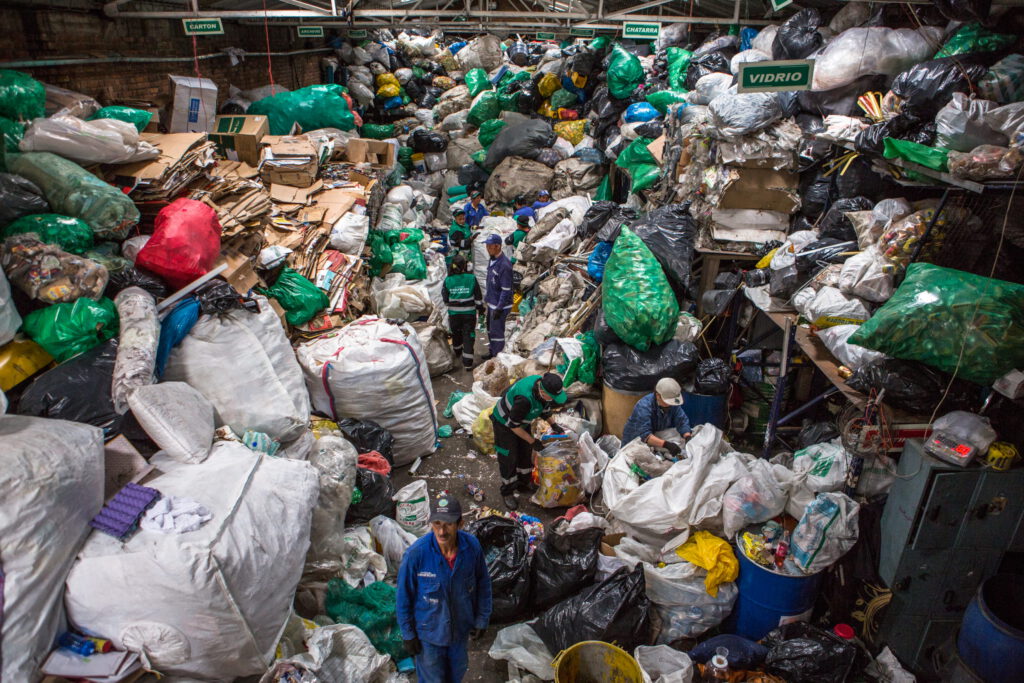
SEWA’s involvement with waste pickers began in 1975 in Ahmedabad. Women textile workers and wives of male textile workers who had lost their jobs and resorted to waste picking for a livelihood, approached SEWA expressing their plight and hardships. SEWA then carried out a sample study of waste pickers and consequently decided to organize waste pickers with a view to increasing their income. As a first step, SEWA approached textile mills and requested their owners to draw contracts with waste pickers to allow them to pick up paper and other dry waste, which would ensure that waste pickers get a steady income and have better working conditions and thus, fewer health hazards as suffered by other waste pickers. SEWA also organized training programmes for waste pickers to educate them and make them aware of their rights. As a major initiative of SEWA in 1978, a general meeting of waste pickers was organized to chartout a future strategy in light of the fact that there was growing instability in their work. It was evident from what transpired at that meeting that creating alternative income generating activities were essential for waste pickers. Some alternative income generating options which emerged in the meeting were – (1) to develop the weaving skills of the women waste pickers particular those who belong to the weaving community work (2) to help those who were willing to do regular cleaning work for a salary, in getting institutional and domestic cleaning work (3) to engage waste pickers, and especially their daughters, in recycling paper and other waste. From time to time different waste pickers’ co-operative societies were formed. Around 1995, Shri Gitanjali Mahila SEWA Audhyogic Stationary Utpadak Sahakari Mandali Ltd was formed whose members were mainly daughters of waste pickers. This co-operative society was involved in manufacturing stationary and paper pulp items such as pens, paper bags, folders, registers, box files, spring files, notebooks, bookmarks, letter boxes, pen stands, CD covers, envelopes which continue to be manufactured and generate income. The mission: To provide alternate livelihood sources for our daughters so they don’t have to resort to waste picking.